Approfondimenti - Insights
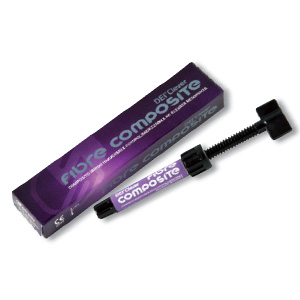
DEI® clever Fibre composite
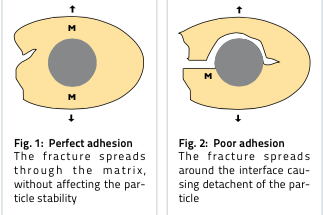
It owns three fundamental characteristics allowing the attainment of resistance values to fracture about six times higher than those of many valuable composites. The first one is the boundary layer of transition that forms at the interface between filler and resinous matrix. This peculiarity, induced by micro-mechanical hooks on the surface of the fibres, gets the absorption and deflection of eventual micro-fractures, increasing the resistance of the restoration and avoiding the formation of splinters and cracks. The second characteristic of mechanical resistance is the silanization of the filler, that in a crucial way increases the cohesion between filler and binder, raising the dispersion values of the forces and avoiding that a weak cohesion of the particles may drastically quicken the abrasion and fracture processes. This treatment is also hydrophobic, consequently resistant to hydrolytic decay (see fig. 1 and 2).
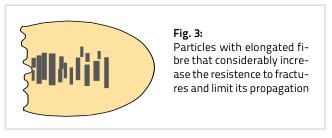
The third very important resistance factor is driven by the presence of elongated particles similar to fibres; offering higher resistance to the forces and to the propagation of eventual micro-fractures, they give the restorations better integrity and longer duration (see fig.3).
The analysis of the problems of mechanical resistance has put in evidence that the composites used in rear quadrants often show defects in homogeneity, superficial micro-fractures caused by high loads or maybe as a consequence of stress by finishing instruments. The resistance of the material to fracture, abrasion and dynamic forces to which it is exposed qualifies the efficiency of a composite in reducing the formation of these micro-fractures, and in case of their occurrence, in resisting to their spreading, avoiding the loss of the restoration.
DEI® Clever Fibre Composite is the result of a revolutionary productive approach. Starting from the above previous considerations this approach can obtain a product with peculiar performances. Owing to its special characteristics, DEI® Clever Fibre Composite is particulary indicates in all situations of high occlusal stress, typical of II class restorations and inlays, so that it is available alternative to restorations in amalgam inlaysM in gold, and to jacket crowns in ceramic.
DEI® clever Fibre composite is indicated for:
- Class I and II restorations
- Sandwich technique restorations
- Prosthetic structures for bridges and crowns
- Reconstructions