Approfondimenti - Insights
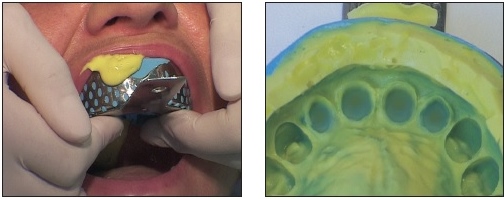
The dental impressions recorded with this new technique allow to reach a quality of details and precision difficult to achieve with other techniques with the maximum simplicity.
The Rainbow Twin technique eliminates in many cases the gingival retraction cord reducing trauma, processing times and sessions.
Dental Impression technique "Rainbow Twin": preliminary clinical evaluations
Dr. Enrico Conserva, DT. Francesco Faraone and DT. Paolo Pagliari
One of the requirements mostly required in the impression techniques in clinical prosthetic, is to have rigidity of the impression carrier such as to transmit, because of the pressure, the material in the gingival sulcus.
Only thus it can accurately record the abutment with its external profile and the defined area over-preparation to restore a profile and an angle of emergency correctly and to achieve a micron marginal precision of the restoration. The ideal material, to achieve this purpose, in addition to the intrinsic features of the material itself, such as:
1. Reproducibility of the details
2. Fluidity
3. Wettability
4. Elasticity
5. Dimensional stability
6. Breaking strength
7. Hydrophilic (ADA specification 19, BSI specification 4269 )
It should possess a rigidity that allows to push the fluid material gently in the sulcus without the need to resort to systems of retraction and without invading the biological width.
For this purpose during the years several impression techniques have followed such as the one with the copper ring or the technique of the bridge in resin guide, all techniques designed to convey under pressure the material into the gingival sulcus and to minimize the thickness and to make negligible the ultimate extent of contraction. The technique of the double impression "Rainbow Twin" encompasses the advantages of the traditional techniques putty- wash with metal impression trays and those of the techniques of single abutments which precisely the copper ring or bridge in resin guide.
This technique uses a first phase in which an addition-curing silicone (DEI® Rainbow Twin Putty)
high viscosity and very low linear retraction (<0.2%) but high shore hardness (ShA 90 to 24 h) and elastic recovery 99.8% is combined with a putty (DEI® Rainbow Putty RT) high viscosity for the first impression with shore hardness of 62 ShA, same linear retraction of the Twin Putty (factor of extreme relevance) and elastic recovery of 99.4%.
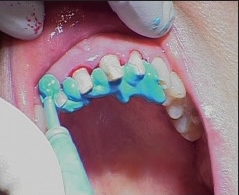
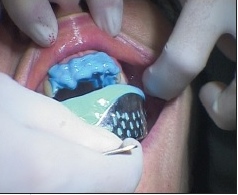
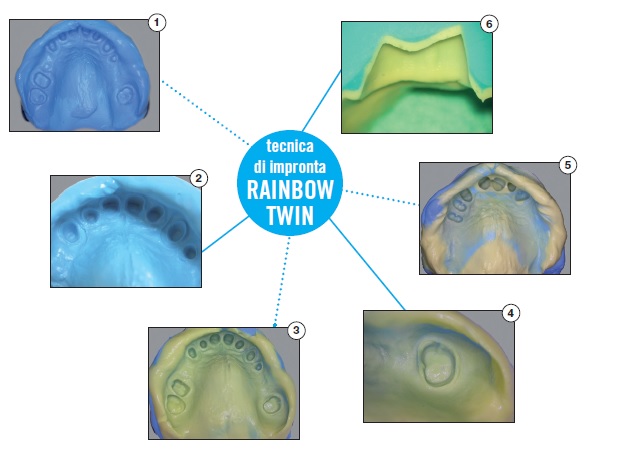
The Twin Putty material is positioned only at the abutments to give rigidity and head the light fast material in the gingival sulcus. (Fig. 1 and 2)
Finished curing, the dental impression is loaded only in correspondence of the teeth not prepared and repositioning in the oral cavity for the second impression with DEI® Rainbow Hydro Fast, material highly hydrophilic, with a contact angle <20 °.
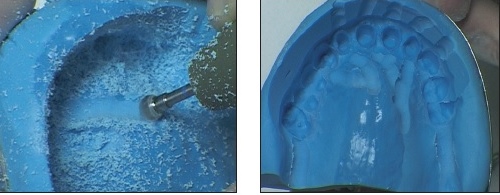
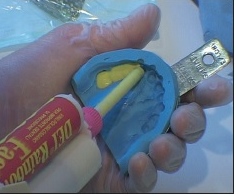
In this way it will be possible to obtain very precise impressions even without the help of systems of retraction mechanically or chemically, with saving of time for the patient and for the operator. (Fig. 3 and 4).
The clinical benefits of the new technique with double impression Rainbow Twin can be summarized as follows:
1. The first impression is transformed into an individual cap for each abutment, rigid, enveloping and with a cervical margin parallel to the clinician neck that can push to pressure the material light fast in the gingival sulcus also without the retraction systems and to detect even the smallest of details (Fig. 5 and 6).
2. The option of not using systems of chemical or mechanical retraction.
3. Curing time and quantity of material reduced with greater relief of the patient.
Of course further studies are needed to better assess the accuracy of such technique.